

China Rubber Profiles Extrusion Line A Guide to Advanced Rubber Profile Manufacturing
2026-11-16
When you hear "China rubber profiles extrusion line," you might picture budget machinery with rough edges. That stereotype is fading fast. SFC builds lines that handle silicone, EPDM, and dense rubber profiles with precision normally reserved for European brands—at a fraction of the lead time. In this guide, we’ll walk through the key decisions in advanced rubber profile manufacturing: vacuum extrusion, microwave curing, and inline cutting. If you're specifying a new line, the details here will save you from costly rebuilds.
Why Rubber Profile Tolerances Start With Compound Viscosity
Getting a rubber profile to hold a tight tolerance isn’t just about tooling or line speed—it starts long before the die, with how the compound moves under pressure. Viscosity is the first property that dictates whether the material will swell, sag, or hold its shape as it exits the extruder. A compound with stable, predictable flow at processing temperatures gives you a fighting chance at keeping dimensions consistent from run to run.
When viscosity drifts too low, the rubber tends to over-swell at the die lip and can slump before it reaches the curing line. That makes thin walls and sharp corners especially hard to control. On the other end, a compound that’s too stiff demands higher head pressure, which changes shear heating and can make the die swell pattern less repeatable. Neither extreme supports the kind of repeatability that tight profile tolerances require.
In practice, compounders adjust viscosity not just to hit a spec sheet number, but to match the profile’s geometry and the extrusion setup. For complex shapes with narrow grooves or unsupported lips, a slightly higher viscosity often helps the profile hold its form in the hot air or salt bath. For simpler, thick sections, a lower viscosity may improve surface finish without hurting dimensional control. Getting that balance right means the die can do its job instead of fighting the material.
What Chinese Extrusion Lines Do Differently for Thin Wall Profiles
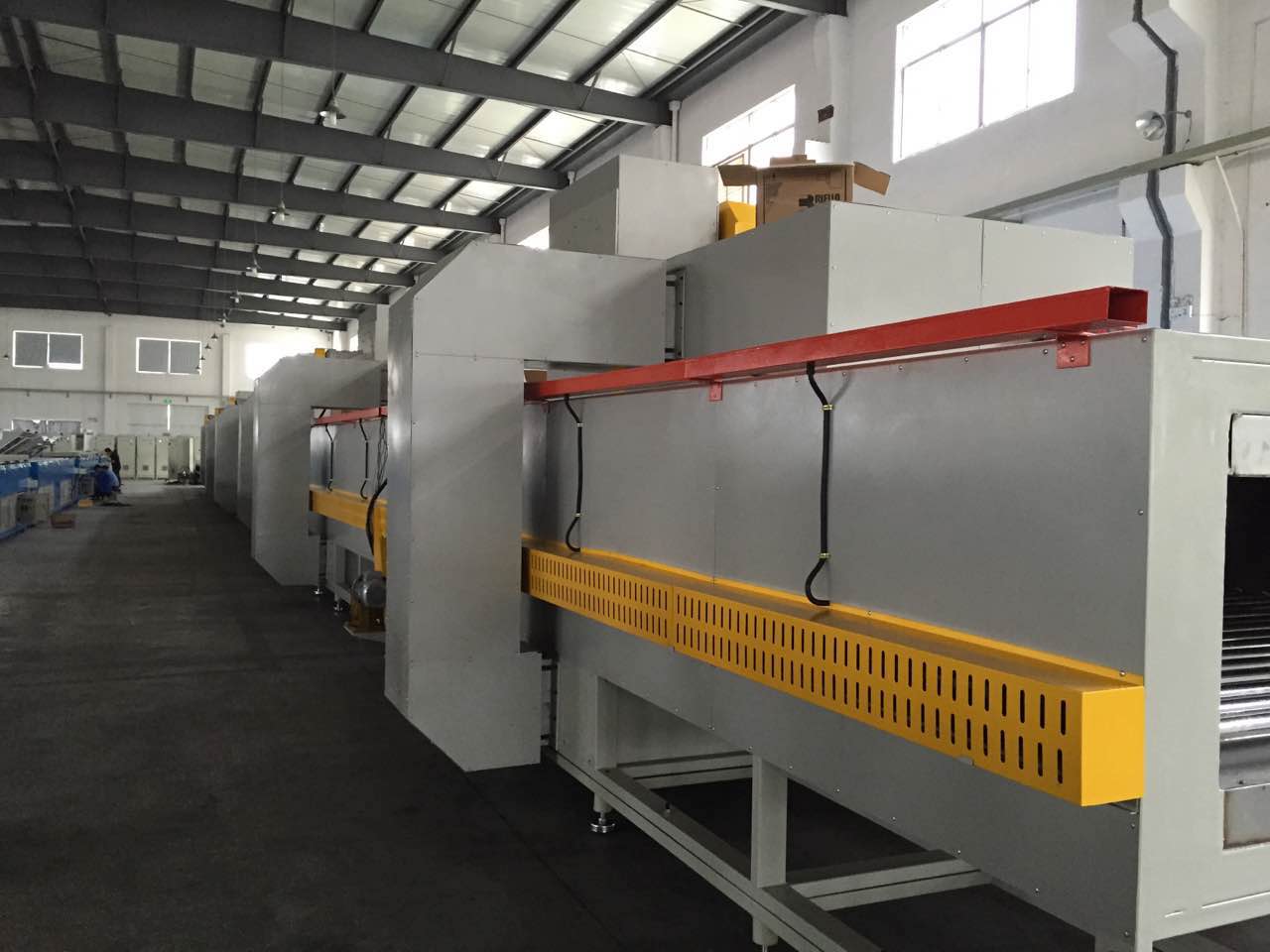
Many Chinese thin-wall profile lines use a shorter, more aggressive compression zone in the screw than European machines of similar output. The feed section is often deepened and the metering section shortened, which pushes material through the die at a more consistent pressure. That reduces the pulsing effect that shows up as wavy walls on profiles under 0.5 mm.
Cooling and calibration setups are also arranged differently. Instead of one long vacuum tank, Chinese builders often split the first calibration stage into two or three short, high-vacuum blocks with independent water circuits. Each block can be adjusted while the line is running, so thin flanges and sharp corners get chilled before they can sag or tear. This segmented approach is especially visible on lines running speeds above 8–10 m/min.
Die design tends to favor replaceable inserts over fully custom die bodies. The land length is kept deliberately short, and the insert profiles are polished to a finer finish to avoid melt sticking at low throughput. Operators also run slightly lower barrel temperatures in the rear zones, which improves surface gloss and dimensional stability for thin-wall PVC or polyolefin profiles without sacrificing output.
Die Land Adjustments That Keep Surface Finish Consistent
Getting a steady surface finish starts with the land length itself. If the land is too short, flow at the die exit hasn't settled and you'll see wavy or rippled edges. Lengthening the land just enough to build consistent backpressure smooths out velocity differences across the profile, but pushing it too far adds shear heat and can drag the surface. A practical check is to run a short trial and watch the extrudate surface as it leaves the die—any pulsing or roughness usually points to land length being off.
On multi-cavity or complex profiles, equal land lengths rarely work because flow paths differ. Stepping the land—shorter where the melt travels farther, longer where it arrives early—evens out pressure drop per flow path. This keeps the surface finish from varying between thick and thin sections. Polishing the land to a consistent finish also matters: a rough or worn land will tear the surface slightly, leaving dull streaks.
Land adjustments aren't a one-time fix. As tooling wears, the effective land length changes, so checking land geometry and surface roughness during routine die maintenance helps hold finish consistency over long runs.
Where Closed Loop Control Outperforms Manual Line Tuning
Manual line tuning falls short whenever the load changes faster than an operator can react. On a coating line that switches between solvent-based and water-based fluids, viscosity swings from batch to batch demand frequent retuning of pumps and valves. Closed loop control watches the actual flow rate and corrects drift continuously, so the same recipe runs with minimal variation no matter what tank gets connected next.
Another clear advantage appears in lines where multiple variables interact. Adjusting a pressure setpoint by hand often triggers a temperature fluctuation or a secondary flow change somewhere downstream. Closed loop control handles these cross-couplings natively, making coordinated moves that keep the whole process stable. This becomes critical on extrusion lines or chemical reactors where a single manual tweak can push the system into oscillation.
High-speed converting and packaging operations show the gap even more sharply. At several hundred meters per minute, web tension spikes or registration drift occur in milliseconds, far too quick for any manual correction loop. Closed loop systems sample sensors dozens of times per second and actuate accordingly, preserving print quality and avoiding waste that would otherwise pile up before an operator even notices the fault.
Continuous Vulcanization Without the Usual Speed Quality Tradeoff
For years, running a continuous vulcanization line meant accepting a quiet bargain: push the belt speed for higher output and watch the cure profile drift, or hold the speed back to keep physical properties in spec and lose throughput. The tradeoff showed up in undercured centers, overcured edges, and a quality lab that never seemed to see the same number twice.
What changes the picture is not a single breakthrough but a tighter coupling of heat input, residence time, and real-time feedback. By shaping the temperature ramp in shorter, independently controlled zones and adjusting dwell on the fly, the line can hold a consistent state of cure even as it accelerates. The result is that throughput and product consistency stop behaving like opposing forces and start moving together.
Inline Vision Systems That Catch Defects Before Coiling
Surface flaws rarely announce themselves. On a coil line running at full speed, a shallow gouge from a worn roll or a pinhole from an inclusion can slip past human eyes in a fraction of a second. That is exactly where inline vision systems have changed the game. Mounted just upstream of the coiler, high-resolution line-scan cameras build a continuous image of the strip as it moves, while dedicated lighting throws even faint topography into relief. The moment a defect crosses the inspection window, the system flags it with a precise position stamp, giving operators a chance to react before the steel gets wrapped under tension.
The real value comes from catching defects while they are still actionable. Instead of discovering a lamination or edge crack after the coil is already in a customer's plant, the system lets the line decide: slow down, mark the section, or divert the strip altogether. Some setups pair the cameras with laser profilers to measure depth, separating cosmetic blemishes from structural threats. This reduces the number of coils held for inspection and keeps the coiling process moving without building in extra handling steps.
Operators quickly learn to trust the steady, unblinking eye of the camera more than a manual spot check. A well-tuned vision system doesn't just record images; it builds a roll map that travels with the coil, showing exactly where each anomaly sits along the length. That level of detail changes conversations with customers and slashes the cost of downstream rejects, because the defect is no longer a surprise waiting to happen. It is already measured, located, and, most importantly, kept out of the finished coil.
FAQ
Modern lines typically integrate vacuum calibration, precise temperature control across multiple zones, and programmable logic controllers that adjust screw speed and haul-off tension in real time. Older machines often relied on manual tweaks and single-zone heating, which led to inconsistent cross-sections and higher scrap rates.
Most advanced lines handle a broad range, including EPDM, silicone, nitrile, neoprene, and natural rubber blends. The key is having a screw and barrel configuration matched to the compound's shear sensitivity, along with a feeding system that prevents premature scorching.
It holds the extrudate in a precisely machined calibrator under negative pressure while cooling water circulates around it. This keeps the rubber from swelling or sagging before it sets, so you get tight dimensional tolerances on complex hollow or flanged profiles without secondary trimming.
The haul-off must pull the profile at a speed matched to the extrusion output without stretching or bunching. A servo-driven cutter then slices lengths to within a millimeter or less. Any mismatch here creates waves, distortion, or uneven ends that downstream assembly can't fix easily.
They often combine heavy-duty frames and imported European or Japanese drives, PLCs, and sensors with locally fabricated screws and barrels. That hybrid approach keeps the price competitive while still meeting tight tolerance requirements, and many factories now offer full turnkey support including die design and operator training.
Regular screw and barrel wear checks are critical because abrasive fillers like carbon black or silica gradually open up clearances and reduce output stability. Also, calibrator and cooling tank cleaning prevents residue buildup that can scratch profiles, and gearbox oil analysis catches bearing wear before it causes downtime.
Yes, if it's equipped with a vented barrel or a vacuum degassing unit to remove moisture and blowing agent by-products. You'll also need rapid temperature drops at the die exit to freeze the cellular structure before the profile collapses, so dedicated cooling baths with adjustable water flow are essential.
Ask for a documented test run using your own compound and a target profile, not just a generic demo. Check whether the supplier builds their own screws and barrels or outsources them, because in-house control over metallurgy and machining usually translates to longer service life and better repeatability.
Conclusion
In advanced rubber profile manufacturing, consistency begins long before the profile reaches the die. Compound viscosity sets the baseline for dimensional stability; without tight control over raw material flow behavior, even the most precise extrusion line will drift out of tolerance. Chinese extrusion lines address this by integrating real-time viscosity monitoring with adaptive screw speed and temperature profiling, rather than relying on fixed recipes. For thin wall profiles, the difference is in how back pressure and drawdown are managed—many lines use dedicated thin-wall screw geometries and low-friction vacuum calibration sleeves that prevent collapse while preserving sharp edges. Die land adjustments are treated as a dynamic variable, not a static setup parameter; operators can fine-tune land length based on surface roughness feedback, ensuring satin or gloss finishes remain consistent across shifts.
Where Chinese systems truly diverge from manual tuning is closed-loop control. Instead of an operator watching a gauge and making periodic corrections, multiple sensors feed a central controller that adjusts haul-off speed, microwave or salt bath temperature, and die pressure simultaneously. This removes the usual speed-quality tradeoff in continuous vulcanization: profiles can run faster without sacrificing cure state or surface smoothness, because the line continuously rebalances energy input against output rate. Inline vision systems add a final layer of assurance, scanning profiles for pits, scorch marks, or dimensional drift before coiling. Defects are flagged by location and type, allowing immediate die or compound correction rather than discovering rejects after the batch is complete. The result is a manufacturing approach where tolerances are actively maintained from raw compound to finished coil, not merely inspected at the end.
Contact Us
Contact Person: Chen Zhengwei
Email: [email protected]
Tel/WhatsApp: +86-13963975727
Website: https://www.sfcrubbermachine.com