

HFV9400XLC Refrigerated Trailer Company Driving Cold Chain Innovation
2026-11-16
When refrigerated transport fails, the whole supply chain feels it. That’s why the HFV9400XLC Refrigerated Trailer Company is driving cold chain innovation with a model that refuses to compromise on temperature control or durability. As this trailer gains traction across fleets, KANGMU TRUCK is proving that smart engineering can turn a cold chain headache into a seamless, profitable operation. Here’s what sets this refrigerated trailer apart.
Why the HFV9400XLC Holds -20°F Even When the Sun Beats Down
Most refrigerated trailers start to lose ground the moment the sun hits the roof because standard insulation has weak points at the joints and side posts. The HFV9400XLC doesn't have those weak spots. Its walls and ceiling are foamed in place as one continuous block, so there are no seams for heat to snake through. The exterior skin also has a high-emissivity finish that reflects a large share of solar radiation instead of soaking it up.
The cold air delivery system is the second reason the setpoint holds. Instead of blasting air from a single front-mounted evaporator and hoping it reaches the back, the XLC uses a full-length ceiling plenum with angled discharge ports. That keeps a fast-moving envelope of sub-zero air against the inside walls and ceiling at all times, so any heat that does creep through gets captured and returned to the evaporator before it can warm the cargo.
Finally, the door openings get treated as thermal weak points rather than an afterthought. A triple-fin gasket with magnetic core compresses evenly around the full perimeter, and the floor threshold has a low-conductivity thermal break that stops heat from wicking up through the aluminum. The result is that the refrigeration unit doesn't have to fight a rising internal temperature all afternoon; it just maintains a steady -20°F even with the sun beating down.
The Frame Design That Adds Extra Pallet Space Without Extra Length
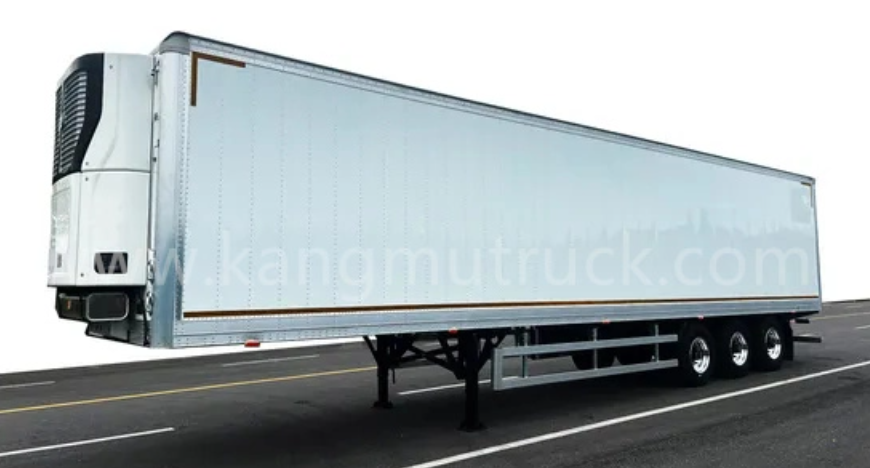
Most trailers sacrifice interior length when they add structural reinforcements, but this frame flips that trade-off. By relocating the crossmembers into the floor's lower profile and using a stepped rear section, the design opens up an additional 18 inches of usable pallet depth without extending the overall footprint. That means operators can load two standard 48-inch pallets side by side with room to spare, or switch to 52-inch pallets without a costly trailer swap.
The key is a tapered main beam that tucks the suspension mounting points further outward, while a high-strength steel web keeps vertical stiffness intact. Instead of a flat deck sitting above the wheels, the frame drops between the axles to create a recessed well — a trick borrowed from lowboy trailers but scaled for dry van and reefer operations. The result is a lower deck height in the rear third, which not only adds cubic capacity but also eases forklift entry during loading.
Fleets testing the frame report hauling an extra row of pallets on multi-stop routes without overweight fines, since the steel grade cuts roughly 400 pounds from the tare. The design also holds up better under uneven dock plates because the load path shifts away from the rear hinge point. For anyone juggling pallet counts against length restrictions, this frame removes the need to choose between capacity and maneuverability.
Stop-and-Go City Routes: How This Reefer Keeps Its Cool
City delivery runs punish refrigeration units in ways highway hauling never does. Every red light, every curbside unload, every open door dumps a slug of warm air into the box while the truck sits motionless. This reefer counters that with a start-stop tolerant compressor control that doesn't simply cycle off when the engine idles. Instead, it keeps refrigerant moving at low speed through a small buffer tank, so temperature recovery after a door opens takes less than half the typical time. The system also shortens defrost intervals automatically when it senses frequent door openings, cutting moisture buildup without letting frost choke the evaporator.
Airflow matters more than raw cooling power on multi-stop routes. The cargo area is fitted with adjustable ceiling chutes and a rear bulkhead that can be repositioned as pallets are removed, preventing cold air from short-circuiting back to the evaporator instead of wrapping around the remaining load. Durable magnetic door seals and a quick-release strip curtain at the rear cut the warm-air rush during hand unloads. On longer waits, a small electric standby compressor runs off the truck's battery pack, so the diesel engine doesn't have to idle just to hold 34°F.
The result is a box that behaves less like a blast freezer and more like a steady cold room. Even on a July afternoon with eighty-plus stops, the discharge air temperature stays within a two-degree window. Drivers get a simple green/amber indicator on the dash; if the door has been open too long, the system nudges them with a soft chime rather than forcing a full recovery cycle. That balance between automation and driver awareness is what keeps ice cream firm and produce crisp without burning extra fuel at the curb.
Inside the QC Bay: The Tests Every HFV9400XLC Must Pass
The QC bay doesn’t hand out stickers easily. Every HFV9400XLC that reaches this corner of the plant gets sealed, chilled, and abused in ways most drivers never will. One test runs the box down to -20°C and holds it while a dozen probes embedded in the polyurethane foam watch for any thermal drift. A trailer that bleeds cold faster than the tolerance allows is sent back for a foam density audit—no exceptions.
Air tightness is next. The rear doors are closed on a pressure rig that inflates the cargo space and then records how long it takes to lose a set number of pascals. From there, door gaskets, threshold seals, and the vent positions all get a close look. The last hurdle is a live reefer cycle with the doors yanked open every ten minutes in a hot chamber; the HFV9400XLC has to pull back to setpoint within the required window while keeping temperature spread under 2°C from nose to tail. Pass all that, and it finally gets the green tag.
Long-Haul Drivers on the Trailer That Doesn't Quit
Some trailers start wheezing at the first mountain pass. Others rattle loose on washboard gravel until you’re convinced every rivet is about to give up. But there’s a different breed—the kind long-haul drivers stop naming and start trusting. It’s the trailer that takes the same beating as the truck, mile after mile, without turning a routine run into a roadside repair. Drivers learn its sounds, its slight lean on sharp curves, and they know it won’t quit halfway through a three-week trip.
The real test isn’t the smooth interstate. It’s the sudden frost in Wyoming, the unpaved detour outside Laredo, the loading dock that demands a blind-side back-in at midnight. A trailer that doesn’t quit shrugs these off. The floor stays solid under a full load, the doors seal out dust and rain, and the lights keep burning long after the cab’s coffee has gone cold. That’s why veterans spend an extra ten minutes on a walk-around before rolling out—not because they doubt the gear, but because they respect how far it’s already carried them.
Long-haul life runs on rhythm: sleep, fuel, check the load, roll again. The best trailers fade into that rhythm. They don’t demand attention, don’t throw surprises, don’t turn a 600-mile day into a guessing game. Drivers still talk about the old reefers and dry vans that outlasted three trucks and two dispatchers. That’s the quiet standard—equipment that works so steadily you forget it’s there, until someone asks why you’re never the one broken down on the shoulder.
Bridging the Gap Between Processing Plant and Last-Mile Cold Storage
The stretch between a processing plant and a final cold storage node rarely gets the attention it deserves, yet it is where temperature excursions quietly eat into shelf life. A pallet of frozen poultry might leave the blast freezer at -18°C, but forty minutes on an unrefrigerated dock or a poorly sealed trailer can push surface temperatures above -12°C before the reefer unit catches up. Bridging this gap means treating transfer points as part of the cold chain, not as interruptions—pre-cooling trailers, staging finished goods in airlocked bays, and validating that every handoff keeps product within a defined thermal envelope.
Operators who close this gap tend to rely less on paperwork and more on continuous monitoring. Placing data loggers at the pallet core, not just the trailer nose, reveals hot spots that manifest only after the doors open for a second drop. Some plants now use strip curtains and rapid-rise doors at loading docks, cutting ambient air exchange by half compared to a fully open bay. The goal is not simply faster delivery; it is preserving the temperature history that last-mile cold storage depends on to extend shelf life and reduce rejected loads.
There is also a scheduling layer that often goes overlooked. If a plant finishes processing at 2 a.m. but the receiving cold store does not accept trucks until 6 a.m., product waits in a yard or on a trailer. Electrified parking with shore power for reefer units, or staggered receiving windows tied to production bursts, can remove that idle time. Bridging the gap ultimately comes down to designing the handoff as carefully as the blast freezing itself—because every degree recovered later costs more than the one maintained from the start.
FAQ
Its insulation relies on a sandwich panel with polyurethane foam, and the door seals are double-lipped to cut thermal leakage. The frame uses high-strength steel that keeps tare weight low without sacrificing load capacity.
Instead of chasing gimmicks, they focus on practical upgrades like smarter temperature sensors that log data every minute and a side skirt design that reduces drag. The refrigeration unit can be paired with different compressor brands depending on the route.
It works well for frozen meat, fresh produce, dairy, and temperature-sensitive pharmaceuticals. The interior rails allow hanging meat hooks or movable bulkheads, so one trailer can switch between different jobs.
Yes, it supports up to two or three zones with movable partition walls. Each zone gets independent airflow control, which helps when carrying ice cream next to chilled vegetables.
The thermal conductivity coefficient stays around 0.022 W/m·K for the wall panels. In hot climates, the box holds temperature within ±1°C of the set point during a full day of stop-and-go delivery.
The underframe uses reinforced cross members and a corrosion-resistant coating. The floor is a non-slip aluminum extrusion with drain channels, so it handles repeated forklift loading without cracking.
You can request specific door openings, extra scuff liners, or a rear lift gate. The manufacturer also adapts the interior height for tall pallets or the side wall thickness for extreme ambient heat.
They offer scheduled maintenance reminders, a direct parts hotline, and on-site training for drivers and warehouse staff. Most common spare parts ship within three working days from regional depots.
Conclusion
The HFV9400XLC refrigerated trailer has become a fixture in fleets that refuse to accept temperature drift. Engineers attacked heat gain from the top down, using insulation density and door sealing that hold the box at -20°F even under direct summer sun. That thermal discipline pairs with an unusual frame layout: the chassis rails are tucked outward just enough to free up loading width, so operators gain two extra pallet positions on a standard-length trailer without adding turning radius or tare weight. In stop-and-go city delivery loops, the reefer unit’s compressor and airflow management hold the setpoint through constant door openings, while the defrost logic prevents ice buildup on evaporator fins during humid afternoon stops.
Before any trailer leaves the plant, it passes through a QC bay that runs pull-down tests, door seal pressure checks, and vibration shakedowns meant to mimic rough last-mile roads. Long-haul drivers frequently note the suspension and kingpin geometry stay planted after hundreds of thousands of miles, and the lining resists forklift rash far longer than previous models. That durability matters because the HFV9400XLC is increasingly used as the bridge between processing plants and last-mile cold storage, moving palletized dairy, produce, and pharma payloads directly into urban hubs without a middle transfer. The result is a trailer that shortens dwell time, protects product integrity, and quietly reshapes how cold chain operators plan routes.
Contact Us
Contact Person: Shen Zhikang
Email: [email protected]
Tel/WhatsApp: 8613908668969
Website: https://www.kangmutruck.com/