

ODM Air Cleaner Selection Tips for Modern Businesses
2026-08-30
Choosing the right ODM air cleaner isn’t just about specs—it’s about keeping your team breathing easy and your operations running smoothly. With modern businesses facing tighter air quality expectations, the selection process can feel overwhelming. That’s where LUFUTATECH comes in: our guide breaks down the key factors without the fluff, so you can make a confident decision instead of guessing.
Assessing Actual Airflow Needs Before Comparing ODM Options
Jumping straight into a side-by-side comparison of ODM fans or blowers without first pinning down the real airflow requirement often leads to mismatched selections. The nominal cubic feet per minute printed on a datasheet rarely reflects what happens once the unit is installed in a ducted system with filters, bends, and varying static pressure. A more reliable starting point is to measure velocity and pressure drop at the exact points where air movement matters, then calculate the actual volume needed under those operating conditions. This avoids the trap of oversizing based on free-air ratings or undersizing due to overlooked resistance.
One practical approach is to map out the most demanding scenario rather than assuming every branch runs at full load simultaneously. In a multi-point exhaust or supply network, it is common for only a portion of the openings to be active at the same time. By identifying the true peak concurrent demand and adding a modest buffer for filter loading or slight duct leakage, you get a target airflow that reflects real operations. This number becomes the baseline for evaluating different ODM options, ensuring that each proposal is judged against the same required duty point instead of vague claims about maximum output.
Another frequent oversight is ignoring the system resistance curve entirely. A fan that moves plenty of air with no restriction may fall far short once connected to a typical setup. Before contacting ODM suppliers, sketch out the expected static pressure at the target flow rate and confirm whether the proposed impeller, housing, and motor can deliver that combination. This level of clarity makes conversations with manufacturers far more productive, because you can immediately filter out units that are not suited to the actual operating envelope rather than getting distracted by impressive but irrelevant peak performance figures.
Filter Customization That Targets Your Building's Specific Pollutants
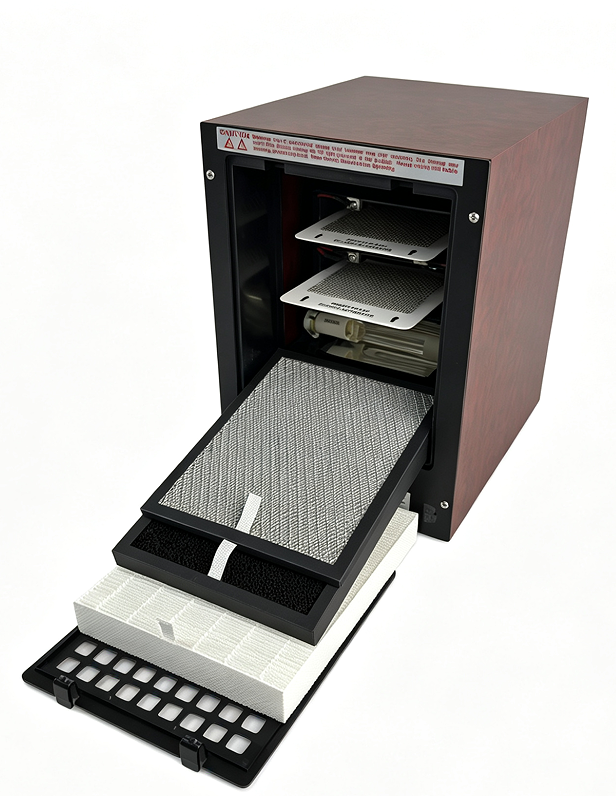
Every building has its own mix of airborne irritants, so a one-size-fits-all filter rarely does much beyond catching basic dust. We sample and analyze the air in your actual spaces, then choose filtration media aimed at whatever shows up—welding fumes, cooking grease, volatile organic compounds from adhesives or finishes, or the fine particulate that drifts in from outdoor traffic.
That kind of targeting changes how a filter behaves. If heavy carbon loading is required to strip odors from a ground-floor restaurant, the media depth and dwell time get adjusted accordingly. For a dental office dealing with aerosolized debris, we lean on higher-efficiency synthetic blends that handle moisture without collapsing. You end up with a system that does its job quietly, instead of just adding resistance to the fan.
Quiet Operation Standards for Open-Plan and Client-Facing Areas
Open-plan floors and client-facing zones carry a specific acoustic burden that private offices rarely do. A single loud phone ring, the clatter of a mechanical keyboard, or a conversation held at full voice can fracture someone's focus or, worse, make a visitor question whether the team respects basic professionalism. Quiet operation here isn't about silence—it's about managing the noise floor so that ordinary work and client conversations can happen without competing against avoidable disruptions.
Practical standards start with equipment and movement. Set all desk phones to a soft ring or, better, to a blinking light with vibration only in shared spaces. Keyboards and mice should be chosen for low actuation noise; mechanical switches with audible clicks are generally unsuitable. Printers, shredders, and other high-volume devices belong in a closed utility room or behind a sound-dampening partition, never within arm's reach of a client seating area. For personal calls or quick stand-ups, use designated huddle rooms or step into a corridor—not the space between desks where your voice will carry across three rows. Even the way you walk matters: hard-soled shoes on a bare floor create a rhythmic thud that can become background irritation by mid-afternoon.
Client-facing areas demand an even stricter layer of discipline. When a visitor is present, lower your speaking volume by roughly thirty percent compared to your normal desk voice, and avoid discussing any account details or internal disagreements within earshot of reception or meeting areas. If you need to reference a screen or document, turn the brightness down and angle it away from open sightlines. Background music or white noise, if used, should stay below 45 decibels—just enough to mask typing and distant chatter without making clients feel like they're in a call center. Finally, audit the space once a quarter by sitting in the client chair for ten minutes during peak hours; the noises you notice there are the ones you've already stopped hearing at your own desk.
Smart Sensors and Automation That Reduce Daily Management Time
Every morning used to start with a walkthrough — checking temperatures, fluid levels, and whether any equipment had drifted out of spec overnight. That routine now takes seconds. Low-power wireless sensors mounted on key assets report their status continuously, and the automation layer only flags what actually needs a human look. The result is fewer interruptions and no more guessing about which part of the facility needs attention first.
The real time savings comes from shifting decisions away from people and into rules that run quietly in the background. When a reading crosses a preset threshold, the system adjusts a valve, reroutes airflow, or logs a maintenance ticket without waiting for a supervisor to notice. Staff still review the daily summary, but they no longer spend hours collecting data or double-checking readings that rarely change.
Over time, the patterns become visible. You start to see which sensors trigger most often, where manual overrides cluster, and which automated responses actually prevent downtime. That kind of insight lets a small team manage a much larger operation without adding headcount — not because the work disappeared, but because the repetitive parts of daily management now handle themselves.
Long-Term Filter Replacement Costs Most Buyers Overlook
When shoppers compare air purifiers or water filters, the sticker price usually dominates the decision. But the real expense often hides in the replacement cartridges. Take a mid-range air purifier that costs $200 upfront: its HEPA and activated carbon filters might need replacing every six to eight months, at $60 to $90 per set. Over three years, that's an extra $360 to $540, nearly double the original purchase price.
Manufacturers know this math well. Many deliberately set the machine price low and rely on proprietary filter designs to lock you into their ecosystem. The pattern mirrors razors and blades, except the blades here can expire even faster if you live in a dusty area or have pets. Generic or third-party filters may cut costs, but they often void warranties or fail to meet the same filtration standards, leaving buyers with a tricky trade-off between safety and savings.
Before buying any device with a disposable filter, calculate the five-year ownership cost, not just the upfront tag. Check the official replacement schedule, the price of each filter, and whether multiple stages need changing at different intervals. Some units require pre-filters every month, main filters twice a year, and UV lamps annually, turning a "budget" appliance into a recurring subscription. A little bit of arithmetic now can prevent a seemingly cheap purchase from becoming a quiet money drain.
Production Consistency Checks for ODM Partners at Any Scale
Consistency checks for ODM partners often fail when the process is treated as a one-time audit. A better approach is to build checks into the production flow itself, so each batch—whether 50 units or 50,000—gets the same core verification without adding unnecessary overhead. Start by locking down the approved sample: the exact materials, torque settings, firmware version, and cosmetic finish that define an acceptable unit. Then require the partner to run a first-article inspection against that locked sample before any line starts moving.
At the line level, focus on the variables that drift most: incoming component batches, operator technique, and machine calibration. Ask for incoming inspection records for the top five high-risk parts, not just certificates of conformance. Spot-check three units per hour per line against a simple go/no-go checklist that includes fit, function, label placement, and packaging. These checks should be done by the partner’s own QC staff, but the records must be shared in near real time—photos and short videos work better than spreadsheets.
For smaller runs, the same framework scales down without losing value. You may not need a full statistical process control chart, but you do need a clear deviation log: any time the partner swaps a component, adjusts a fixture, or reworks a batch, it gets written down and flagged before shipment. That log, reviewed before you approve dispatch, catches most consistency issues that slip past final inspection. The goal is not more paperwork; it’s making the partner’s own consistency visible to you at any scale.
FAQ
Look for a partner that owns the core design files and can show third-party lab test data, not just marketing sheets. Ask about their bill of materials: motor brand, filter media source, sensor calibration process. If they hesitate to share those details, you are likely dealing with a generic reseller.
Ask for CADR figures measured at the unit's highest setting and, more importantly, at the noise level you can tolerate. Commercial spaces need performance at mid-speed, not just max. Request a decay test in a room similar to your floor plate, and compare clean air delivery per watt rather than just the advertised square footage.
Focus on high-efficiency particulate filters paired with substantial activated carbon beds if your office has outdoor pollution or printing areas. Avoid designs that rely on ionizers as a primary method; they can generate ozone and complicate maintenance. A well-sealed filter bay matters as much as the media itself.
Noise is often the first complaint after installation. For open offices or hotel lobbies, target units that stay under 45 dB at the speed needed to achieve your air change goal. Ask the ODM for sound power measurements, not just sound pressure at one meter, and look at the fan curve to see if quiet operation collapses airflow.
A capable manufacturer will have a documented process for tooling ownership, component sourcing, and quality control at each production stage. Ask for a pilot run of 20-50 units with your exact specifications before committing to a larger order. Check whether they retain alternative suppliers for critical parts like motors and power boards.
Consider smart sensor integration, scheduled operation tied to occupancy, and modular pre-filters that staff can swap without tools. These details reduce the burden on facilities teams and make the units part of daily workflow rather than a forgotten box in the corner. Ask for a control panel that shows filter life in plain language.
Choose a design where the filter is accessible from the front or side without moving the unit. Confirm that replacement filters will be available for at least five years, with clear part numbers and predictable lead times. A good ODM partner provides maintenance kits and simple instructions that a non-technical employee can follow.
Standard filters work for general dust and pollen, but if your business handles solvents, cooking odors, or wildfire-season smoke, custom carbon blends and thicker media are worth the investment. Work with the ODM to define the target contaminant and test a sample before finalizing the specification. Do not pay for arbitrary upgrades without a clear performance link.
Conclusion
Before you start comparing ODM air cleaners, spend time mapping the rooms where units will actually run. A high clean air delivery rate means little if the fan is sized wrong for your ceiling height or the way air moves through partitioned spaces. Look at the real-time occupancy, not just square footage. Once you know the airflow, ask your ODM partner how they handle filter media selection. A building next to a highway needs different particulate capture than an office dealing with off-gassing from new furniture or a medical suite managing bioaerosols. The right filter should be chosen for your specific pollutant profile, not taken from a generic catalog. And don't ignore noise. In an open-plan office or a client-facing reception, a unit that sounds like a jet engine will get switched off the first week. Ask for sound level data at the speed you'll actually use, not just the lowest setting.
Smart features can save a lot of daily hassle, but only if they work with your building's rhythm. Look for sensors that adjust fan speed based on particle counts or occupancy, and automation that shifts modes after hours without someone touching a control panel. That said, the real cost often hides in replacement filters. A cheap unit might need new filters every three months, while a better design lasts a year. Ask for the cost per year of filter changes, including shipping and labor, before you commit. Finally, don't assume an ODM partner's sample unit represents everything they ship. Request batch-level test reports, check weld and seal consistency, and ask how they handle deviations in production. A clean sample is easy; consistent output at scale is what protects your business long term.
Contact Us
Contact Person: Paul Luo
Email: [email protected]
Tel/WhatsApp: 0086-19966314501
Website: https://www.lufutatech.com