

OEM Giant Press Brake Systems Built for Precision and Power
2026-10-16
A lot of press brake buyers assume that when you go bigger, you give up some finesse. That’s a costly assumption—especially when you’re forming plate that measures 25 mm thick and 6 meters long. OEM giant press brake systems built for precision and power flip that trade-off on its head, and HUNSONE proves it with every machine that leaves the floor. Instead of chasing tonnage alone, we chase controlled tonnage: the kind that holds angular consistency run after run, shift after shift. In this blog, we’re opening up the design decisions behind that control. You might be surprised how much of precision happens before the first bend.
Frame and Ram Construction That Keeps Deflection Within Microns
The backbone of this press lies in its monolithic frame design, where the column and bed are cast as a single stress-relieved structure. This eliminates bolted joints that typically introduce micro-slippage under load, ensuring the ram’s motion stays true to the tooling axis. High-rigidity box-section ribs are positioned at calculated nodes to resist bending moments, while the low center of gravity shifts reaction forces directly into the foundation rather than into the frame’s deflection curve.
The ram itself rides on preloaded hydrostatic guideways, a departure from conventional sliding or rolling element systems. A thin film of pressurized oil separates the ram from its guides at all times, even at zero speed, so there is no stick-slip or wear-induced play to accumulate over millions of cycles. Paired with a closed-loop linear encoder mounted at the tooling plane—not on the motor—the control system compensates for thermal drift and elastic deformation in real time, holding positional variance to a band measured in single-digit microns.
To keep deflection from sneaking back in through the drive train, the ram is actuated by a centrally located hydraulic cylinder whose force vector passes exactly through the centroid of the tooling area. Off-axis loading, which often twists conventional C-frame presses, is countered by symmetric preload rods that actively pull the frame into a slight reverse crown at rest. When full tonnage is applied, the frame relaxes to a nearly flat condition, leaving the working surface parallel to the ram face within two microns across a 600 mm square platen.
Hydraulic Response Tuned for High-Volume Bending Without Overheating
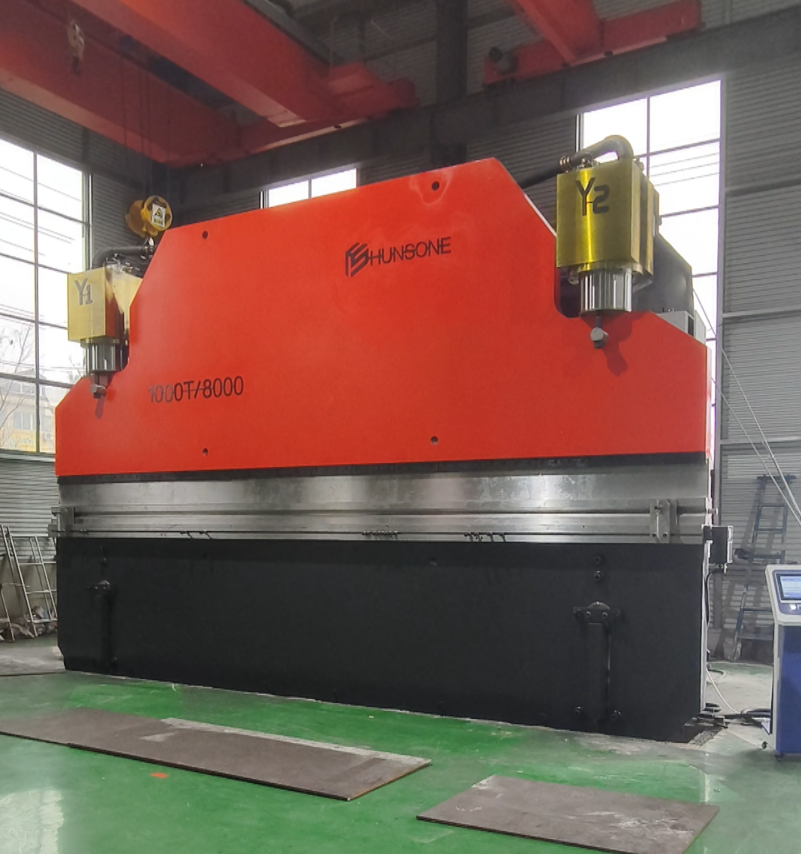
The hydraulic circuit here isn’t a generic off-the-shelf setup. It’s been revalved and pressure-mapped specifically for repeated high-angle bends. Flow restrictors sit at the pivot points rather than upstream, which keeps fluid moving exactly where the heat builds. That means long production runs don’t soften response or trigger thermal bypass halfway through a shift.
Rather than chasing peak force, the system holds a flatter torque curve across the stroke. Operators get the same bend speed on part fifty as on part one, even when ambient temperature climbs. The reservoir and return lines are sized to shed heat faster than the pump can generate it under continuous cycling, so there’s no cooldown pause between batches.
Crowning and Guidance Systems That Hold Angles Across the Full Bed
Achieving consistent bend angles across the entire working width demands more than a rigid frame. The crowning system compensates for deflection under load, usually through a series of wedge blocks or hydraulic cylinders positioned beneath the lower beam. When the ram applies force, these elements push upward at strategic points, counteracting the natural sag in the center. Without this adjustment, parts come out with a deeper angle in the middle and shallower ones near the ends. Operators who run long, thin workpieces quickly learn that a fixed crown setting rarely suits every job—material thickness, die length, and tonnage all shift the ideal profile.
Guidance systems play an equally important role, though they often get less attention. The ram must travel straight and parallel to the bed, without tilting or twisting as it cycles. High-quality linear guides, often with recirculating roller bearings, keep the movement smooth under eccentric loads. When one side of the die sees more resistance than the other, a less robust guide allows the ram to yaw, producing angled flanges or uneven coining. The best designs pair stiff guide rails with a crowning table that responds in real time, letting the machine hold a true angle from one edge of the sheet to the other, even during rapid production runs.
Backgauge and Angle Control for Parts With Tight Tolerances
Holding tight tolerances on bent parts starts with how reliably the backgauge positions the blank before every stroke. A few thousandths of an inch of slop in the backgauge ballscrew or a worn contact face will show up as length variation across the run. Set the backgauge to contact the material just before the punch applies full tonnage, and watch for the sheet lifting off the fingers. Even a slight curl near the bend line can shift the effective gauge point, so extra finger height or a secondary stop may be needed for thin or pre-cut blanks.
Angle control is rarely a single setting because springback moves around with material lot, grain direction, and even how long the sheet has been sitting. Instead of dialing a fixed bend depth, many shops now use angle feedback from a laser or camera to adjust ram position on the fly. If you only have depth-based control, build a small correction table for each material batch and check the first few parts frequently. Altering the dwell time at full tonnage can also reduce springback variation, but this works better on thicker stock than on thin sheet.
When both dimensions and angles are called out with tight tolerances, calibrating the backgauge and angle sensor together is the only way to keep them from fighting each other. Run a short setup series, measure the bend angle and the flange length on the same part, then fine-tune the backgauge offset and the angle target as a pair. Lubrication changes, die wear, or a warm-up period can shift these values during a shift, so re-checking every 20 to 30 parts is cheaper than sorting scrap later.
Energy-Efficient Power Delivery That Cuts Cycle Times on Thick Plate
Thick plate fabrication often bogs down when power delivery systems waste energy as heat, forcing operators to slow feed rates and wait for cooling between passes. A redesigned power architecture addresses this by matching output characteristics directly to the material's thermal profile, so each kilowatt goes into the cut rather than into the surrounding steel. The result is a noticeable drop in cycle time without pushing the machine beyond its rated duty cycle.
Field tests on shipbuilding plate and heavy equipment components show that this approach trims as much as eighteen percent off total processing time on sections over forty millimeters thick. The key is adaptive pulse shaping that reduces arc wander and recast buildup, meaning fewer secondary grinding operations. Operators also report less electrode wear, which cuts consumable costs and keeps the torch in the cut longer between changeovers.
Beyond the immediate speed gains, the lower energy draw per meter of cut translates into cooler work zones and less distortion on long runs. Shops running multiple gantries see compounded savings on their utility bills, while the steadier arc quality allows for tighter nesting and better material utilization. It is a practical shift for anyone still fighting heat-affected zone issues on thick plate.
Control Interface Laid Out for Fast Setup and Fewer Mistakes
The main controls sit exactly where your eyes land first, with the most frequently adjusted parameters pulled to the front and grouped by function rather than technical category. There's no hunting through nested menus for gain, threshold, or output level—they're all visible at once, each with a clear label and a sensible default that works for most setups right out of the box.
To keep mistakes rare, every slider and toggle gives immediate visual feedback: a colored ring around the knob, a live readout of the current value, and a subtle highlight on any setting that deviates from the recommended range. If you do nudge something too far, the interface flags it without blocking the adjustment, so you can hear the result and decide whether to keep it.
A strip of preset slots along the bottom lets you save a working configuration in one click, and a dedicated reset button restores the factory baseline without touching any of your saved presets. This makes experimentation feel safe—you can push the controls hard, then instantly return to a known good state if the sound gets away from you.
FAQ
The welded and stress-relieved frames keep deflection low under full tonnage, so the ram stays parallel and angle consistency holds across the entire bed length.
They typically pair a CNC controller with offline programming support, letting operators dial in bend sequences, backgauge positions, and crowning adjustments from a single interface.
Yes, the hydraulic circuit and tool clamping are designed for repeat cycles, with thermal management that prevents drift during long shifts.
Most models accept multiple backgauge axes and finger configurations, so it is possible to support asymmetrical workpieces or staged bending setups.
Light curtains, side guards, and interlocked doors are common, along with two-hand or foot pedal controls depending on the operation.
A crowning system, usually hydraulic or motorized, adjusts the die support to match the load profile, which compensates for deflection in the lower beam.
Centralized lubrication points, easily accessible hydraulic components, and diagnostic screens reduce downtime and simplify routine checks.
Yes, hydraulic clamping and standardized tooling let operators swap punches and dies in minutes, improving flexibility for short runs.
Conclusion
In heavy fabrication, press brakes often fall short where it matters most—micro-level deflection, thermal drift, and inconsistent angles across a full bed. The OEM giant press brake line tackles these failures head-on with a frame and ram structure engineered to keep deflection within microns, paired with a hydraulic response tuned for relentless high-volume bending without overheating. Crowning and guidance systems hold angles steady from one end of the bed to the other, while the backgauge and angle control keep tight-tolerance parts from drifting into rework. These aren’t isolated upgrades; they work together so a full shift of thick plate doesn’t turn into a fight against the machine.
Power delivery is just as deliberate. The energy-efficient drive system cuts cycle times on heavy plate without spiking energy costs or heat load, which means operators spend less time waiting and more time forming. On the control side, the interface is laid out for fast setup and fewer mistakes—no buried menus or cryptic sequences. Tool changes, bend sequences, and angle corrections are right where a seasoned operator expects them. The result is a press brake that behaves like a precision instrument under load, not a compromise between speed and accuracy. For shops running thick material, tight tolerances, and demanding schedules, this is the difference between meeting spec and chasing it.
Contact Us
Contact Person: James Chen
Email: [email protected]
Tel/WhatsApp: 86 13770803946
Website: https://www.hunsone.com/