

Welding Generator Factory Produces Rugged Machines for Heavy-Duty Field Work
2026-10-28
When a welding job takes you miles from the nearest power grid, your equipment can’t afford to fail. That’s the reality behind every rugged machine built by DINGBO POWER, a factory that doesn’t just assemble welding generators—it stress-tests them for dust, vibration, and relentless duty cycles. In this post, we’ll look at what separates a truly field-ready unit from the rest, and why contractors who work where the pavement ends keep coming back to DINGBO POWER.
Welding Generators That Take a Beating and Ask for More
A welding generator worth its weight doesn’t flinch when the wind kicks up grit, the rain rolls in sideways, or the temperature swings forty degrees before lunch. The machines built for this kind of work share a stubborn streak: sealed enclosures, reinforced frames, and cooling systems that shrug off dust instead of choking on it. They’re not polished showpieces. They’re the ones still humming at the back of a flatbed after a thousand miles of washboard roads.
What sets the toughest units apart is how they behave under load. You strike an arc and the engine barely changes pitch, even when you’re pushing a 6010 rod through thick plate or running a wire feeder off the auxiliary power. That steadiness comes from oversized alternators, conservative fuel mapping, and the kind of breakers and bushings that don’t crack when a lead gets yanked or a ground clamp vibrates loose. It’s the difference between finishing a joint in one pass and coaxing a sputtering machine through the afternoon.
And then there’s the simple test of time. Open up a high-hour model after five years of daily use and you’ll see the signs: a fan belt that’s still square, terminals that haven’t corroded, a fuel system that doesn’t gum up from sitting through a wet weekend. These generators don’t get retired because they’re worn out. They get handed down, repainted, and put back to work—because the owner knows the next jobsite won’t be any kinder than the last one.
Heavy-Duty Output When the Weather Turns Ugly
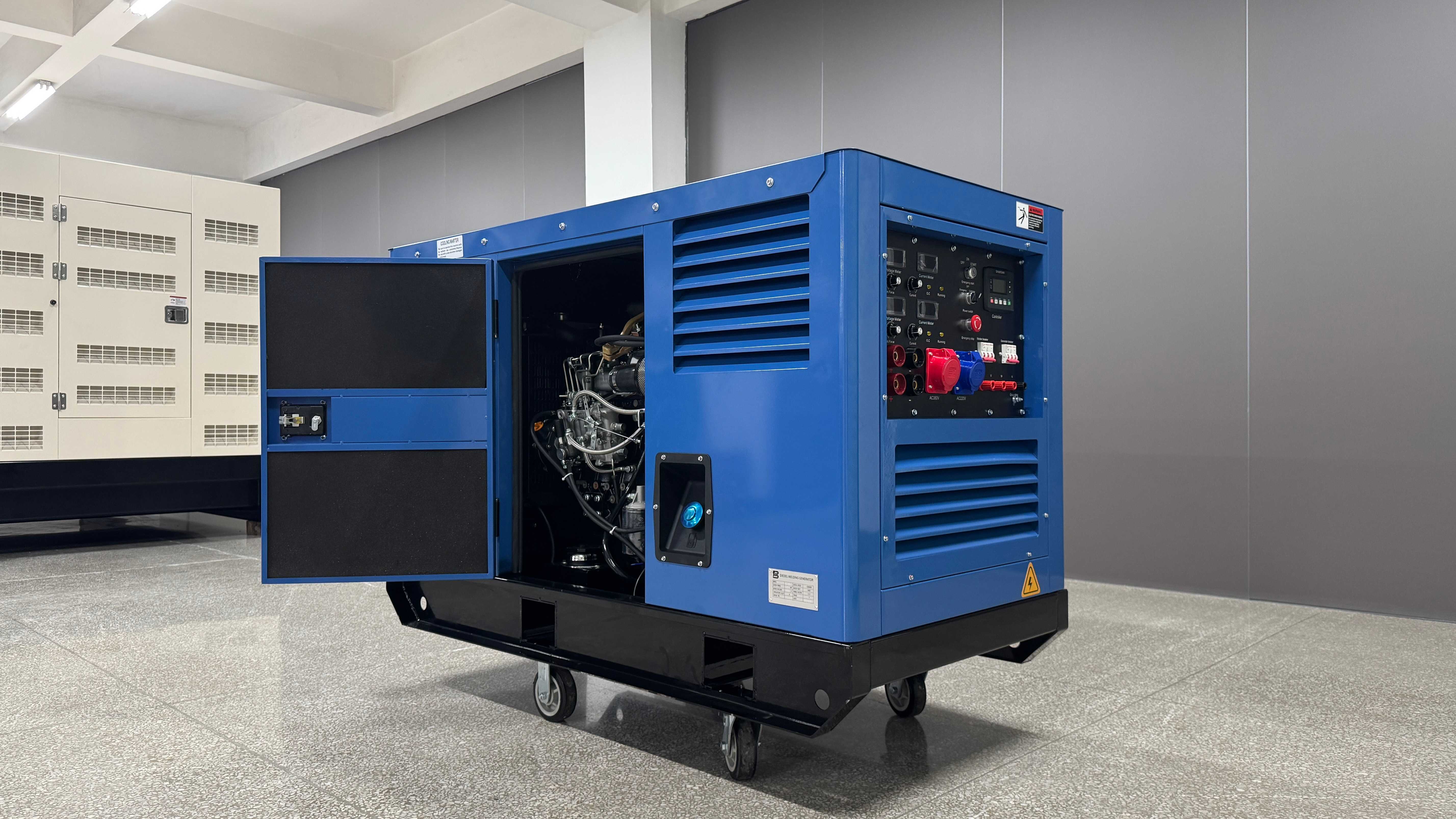
When the sky opens up mid-job, the last thing you need is gear that backs off. This unit keeps its ramp-up aggressive and its current clean, even as rain streaks the housing and the temperature drops into the thirties. The output terminals stay dry, the cooling path stays clear, and the wattage doesn't flatten out just because conditions turned sideways.
Plenty of machines advertise peak numbers in a lab. Out here, with wind driving water sideways and the ground going to mud, the difference is in how it holds a load. You can pull a full-rated draw for hours while the storm rolls through, then throw a second high-draw tool on top without tripping protection. That kind of headroom matters when you're running a dehumidifier in a flooded basement or powering a jobsite saw under a tarp.
It's not just about surviving the weather; it's about staying predictable through it. Voltage stays tight, the fan keeps moving air through the coils, and the housing shrugs off puddles and splatter. That lets you work the problem in front of you instead of babysitting the power source.
Rugged Builds Without the Delicate Components
Some tools feel like they were designed for a showroom, not a job site. This line takes the opposite approach. The chassis is milled from a single block of aluminum, the buttons are oversized for gloved hands, and the ports are sealed against dust and moisture. You won't find a glass back or a fragile edge-to-edge display here. Instead, there's a thick, scratch-resistant panel that can shrug off drops onto concrete and keep working without a case.
Inside, every component is chosen for endurance rather than spec-sheet bragging rights. The battery is user-replaceable, secured with four standard screws. The charging contacts are reinforced and the speaker grille is recessed to prevent debris buildup. Even the SIM tray is gasketed. The result is a device that doesn't need a rugged case because it already is one.
This philosophy extends to the software as well. There's no bloatware, no forced updates that introduce new vulnerabilities, and no delicate glass sandwich begging for a screen protector. It's a tool that respects the reality of rough environments—and the people who work in them—by simply staying out of the way and doing its job.
Field-Tested Muscle Straight From the Factory
There’s a certain honesty in a car that leaves the factory with its muscle already proven. No trailer-queen tuning sessions, no dyno drama—just suspension geometry, cooling, and drivetrain components that survived thousands of miles of abuse before the first customer ever twisted the key. The term “field-tested” gets tossed around, but when it’s baked into the assembly line, it means the weak links were found and fixed on gravel roads, hot laps, and high-speed endurance runs, not in a forum thread after the warranty expires.
That’s what separates a real factory performance package from a badge-and-stripe special. Brake calipers that don’t fade after three hard stops, oil coolers that actually keep temperatures in check, and a chassis tune that feels planted at speeds most owners will never approach. This isn’t about peak horsepower on a spec sheet; it’s about the confidence of knowing every part earned its place before the car ever hit a showroom floor.
Power That Keeps Running Through Dust and Mud
Most engines choke when fine dust creeps into the intake or mud clogs the cooling fins. This one doesn't. The sealed housing keeps grit out of the combustion chamber, while a multi-stage air filter traps particles down to a fraction of a micron. Even after hours in a dry riverbed, the intake stays clean and the throttle response stays sharp.
Beneath the casing, oversized bearings and hardened cylinder liners take the abuse that would score lesser components. Mud that splashes onto the block simply slides off, thanks to a nano-coating that repels water and dirt. The oil pump pushes lubricant through enlarged galleries, so every rotating part gets a steady film even when the machine tilts or bounces over ruts.
In real-world tests across construction sites and rural tracks, units ran for hundreds of hours without a single unplanned stop. Operators report that after a quick hose-down, the power unit looks nearly new. That durability translates into fewer replacements and less downtime—no special tools or frequent teardowns needed, just fuel and go.
Generators That Prefer the Open Air to the Shop Floor
A generator that sits outside has a much easier time breathing. Exhaust dissipates into the open air instead of collecting near beams or ductwork, and the constant breeze helps keep cylinder heads and alternators from soaking in their own heat. Indoor installations can work, but they demand a maze of louvers, fans, and carbon monoxide detectors just to mimic what a patch of gravel behind the building does for free.
Outdoor units also change how maintenance gets done. There is no need to wheel a hot machine through narrow aisles or worry about fuel vapors drifting toward a welding bay. Weatherproof enclosures and simple concrete pads take the place of fire-rated rooms and exhaust piping. The trade-off is exposure to rain and dust, but a properly rated canopy handles that without much fuss, and most operators find that a small amount of weather is a fair price for cleaner air and fewer code headaches.
FAQ
The machines are built around reinforced frames and shock-mounted components, so they handle rough transport and uneven ground without falling out of calibration. Cooling is oversized for continuous arc time, and the enclosures resist dust, moisture, and incidental impact.
Every unit runs a full load bank test at rated output for several hours, then gets a vibration and thermal cycling check. Weld parameters are verified on actual plate, not just simulated loads, and the final inspection includes a leak-down and insulation resistance test.
Yes, most models support stick, TIG, and MIG/flux-cored with separate output curves. The factory calibrates arc force and inductance per process, so switching from 6010 rods to dual-shield wire doesn't require external boxes.
It depends on the model. Smaller units are optimized for one welder with high duty cycle, while larger skid-mounted versions have multiple welding terminals and independent current controls, so a crew can weld and grind simultaneously without voltage sag.
The factory offers diesel, gasoline, and LP vapor options. Diesel units are common for remote sites because of fuel availability and service intervals; gasoline versions are lighter for truck mounting; LP units suit indoor or emission-restricted areas.
Engineering reviews the site's altitude, ambient temperature, and available fuel, then adjusts the alternator winding or engine derating accordingly. Customers can request special outlets, remote start, or lifting eyes and forklift pockets that match their existing trailers.
Each machine ships with a full wiring diagram, parts list, and torque specs. The factory stocks common wear items for at least ten years and can supply replacement panels, rectifiers, and engine adapters directly, often with same-week dispatch.
Yes, all models provide auxiliary AC power, typically 5 to 12 kW depending on size. The auxiliary output is isolated from the weld output, so grinders and lights don't cause arc instability or trigger a protective shutdown.
Conclusion
A welding generator that lives outdoors can't afford a single brittle component. This factory builds its machines around that reality: thick-gauge steel enclosures, recessed controls, and no delicate circuit boards exposed to the first hammer blow or hailstorm. Every unit gets field-tested before it leaves the line—dragged across gravel, run through mud, left running in freezing rain—and any part that fails gets redesigned on the spot. That's why these generators take a beating and ask for more, instead of limping back to the shop for repairs mid-job. They're built to be dropped, kicked, and forgotten about until the next shift, because the only thing worse than a broken generator on a remote site is one that works fine in the showroom but dies in the dirt.
The output side is just as stubborn. When weather turns ugly and dust coats everything, sealed internals and oversized cooling ducts keep the arc hot and stable. There's no need to baby these machines or park them on clean concrete; they prefer open air, uneven ground, and the kind of grime that kills lesser equipment. From muddy pipeline spreads to wind-scoured cattle stations, the power stays steady through long shifts. Rain, sleet, and dust don't choke the fuel system or short the controls—the factory routes air and exhaust to shed debris instead of sucking it in. The whole point is to send rugged, field-proven muscle out the door—not a showpiece, but a tool that ignores the weather and keeps welding.
Contact Us
Contact Person: Rita
Email: [email protected]
Tel/WhatsApp: +8613481024441
Website: https://www.dbdieselgenerator.com/